
Trust Yourself and Be The Leader of Your Personal Safety
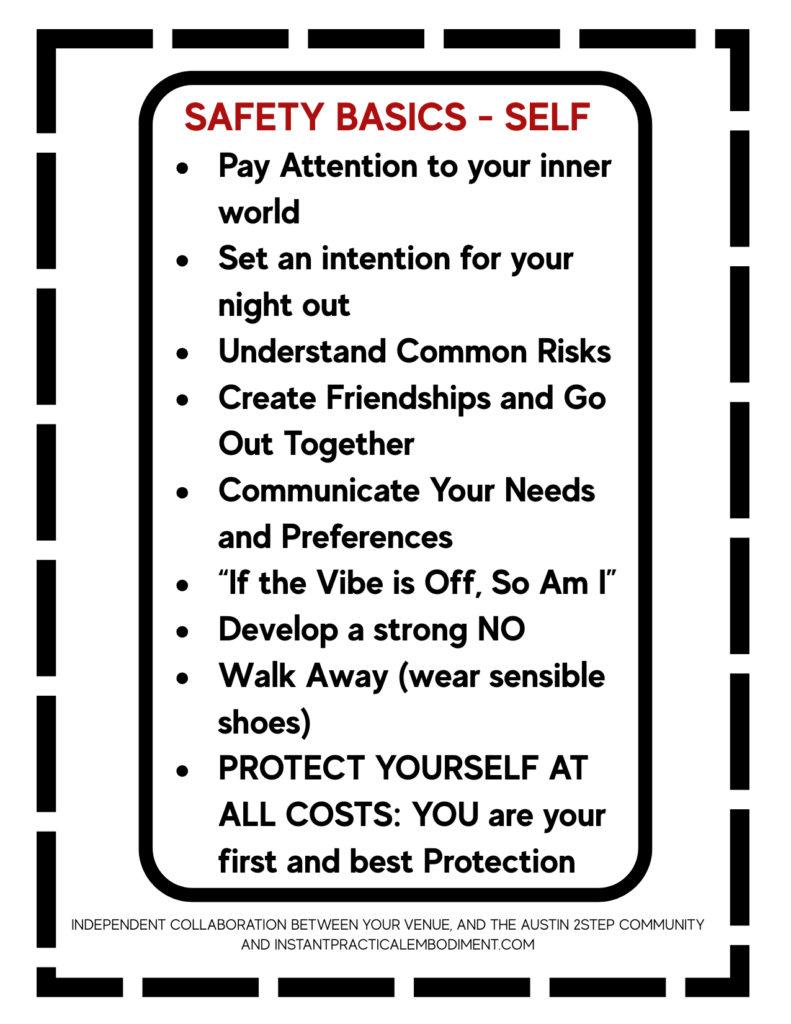
- Pay Attention to your inner world
- Set an intention for your night out
- Understand Common Risks
- Create Friendships and Go Out Together
- Communicate Your Needs and Preferences
- “If the Vibe is Off, So Am I”
- Develop a strong NO
- Walk Away (wear sensible shoes)
- PROTECT YOURSELF AT ALL COSTS: YOU are your first and best Protection
Techniques, Tools and Resources to support your personal safety skillsets for Life!
“Connect, Relax and Celebrate;” “Have a Good Time, Feel Comfortable, Be Safe.” – safe bars.org
Set yourself up for success
Decide on your mood and what you want to experience for a night out dancing! “Fun, Activity, meet new friends, meet a potential love interest!” Having an intention will help you sort out other people’s intentions and energy from your own. Affirmations become an anchor for energy. If a stranger (or friend) approaches you and their energy doesn’t match your intentions for the evening, it’s a clear sign to give them some space, and focus on enjoying your evening with trusted allies.
Go with groups
Those of us who dance here, have all experienced the excitement and pull of the drive to DANCE! However, all the benefits of dance come with challenges and risk. Even one other person who knows your venue of choice for the night is an added layer of safety and personal protection against the “dark forces of the night.”
Opportunistic predators capitalize on your vulnerability and joy in a moment of a night out. They may attach themselves to you or your group, attempt to ride out your joy, absorb themselves into your friend group., ingratiate themselves by dancing, guiding and teaching, being fun and playful, engage with peers and other girlfriends, in order to gain access and to wear down your walls.
Personal Protection & Power-Based Personal Violence
Risk can take many forms:
Interpersonal and relational risk
Psychological and emotional risk
Financial and Resource Risk
Experiencing a night out in Austin, risks are heightened through street and venue exposure, alcohol use, overconsumption, abuse or leveraging, as well as subtle and direct harassment and assault.
Specifically in the dance community, you are most likely to experience the following:
Financial risks such as theft, mugging, car theft, having your things or your bag taken at the venue, etc.
Psychological and emotional risk via exclusion, social pressure,
Relational risk
Tuning In To YOU:
Trust yourself, your responses and your Instincts. Your Neuroception is constantly responding to input from your environment, faster than your thoughts can process, directly into your brain stem and Amygdala, the oldest and most primal part of your brain. Neuroception is what turns your gut and prickles the hairs on the back of your neck when you feel imminent danger.
Social Anxiety, Fight Flight Freeze Fawn and Your Nervous System
Autonomic Response is what happens in your hind brain. The Vagus nerve responds almost instantaneously to your neuroception with somatic feedback mentioned above. We may also cover our midsection, hunch or shoulders or “shrimp,” which is dorsal vagal activation or armoring. These are all normal responses to social uncertainty. As social mammals, social approval is deeply connected to our Confidence and our Survival.
Most of us are familiar with the Autonomic Protective Responses of: Fight or Flight. These are Sympathetic Activations which support us responding directly and immedistely to risk or danger.
Freeze is the initial nervous system response that places us in Risk Assessment mode. For most people, it comes prior to Fight or Flight, and for many people, its possible to get stuck in Freeze, for any length of time (including a lifetime).
Fawn is a less-known component of survival protection, as explained by Dr. Stephen Porges in the Book Polyvagal Theory. Fawn is a quality that signals predators and abusers that we are a person who can be made compliant. Fawn is often a pattern developed by socially disenfranchised individuals, who lack the physical strength or social trust to Fight or Flight in order to protect themselves. Fawn is a form of performative ingratiation, an impulse to please and soothe our aggressor, usually in a transactional way, for example, an aggressive and abusive parent will activate a fawn pattern in their child, because the child is completely dependent upon the parent for survival, they adapt to the abuse in a way that best suits their survival.
If these patterns aren’t made conscious and integrated with our intention, therapy work, somatic healing, etc., they become patterns we unconsciously reenact, not solely in Power imbalances like our working relationship or our intimate partnerships, but also with peers, colleagues, etc. Bringing these unprocessed internal dynamics into an environment like the Austin 2Step Community, can be a recipe for disaster, both personal and social.
How can regular dancers help?
Many of us have been in this scene for some time. We’ve observed its changes, its nuances, and its inherent risks. When new people enter our space, serving as a temporary Host and Guide, INCLUDING setting potential victims up for success, is paramount to supporting a safe and fun community for everyone.
In our Dance Safety Survey results, one of the biggest pain points was the lack of communication and trust within our community, and the fission of new dancers vs seasoned dancers. New dancers often feel it is difficult to “break in” to the cliques that naturally form in a broad mixed social scene. Seasoned dancers feel unsafe when an inexperienced dancer doesn’t understand and adhere to the safety and social etiquette they are used to.
This gap leaves new dancers vulnerable to Predators who are eager to step in and perform the role of Rescuer, Hero, Guide, Teacher in order to gain access to a potential victim.
Opportunistic predatory behavior is primed to target vulnerable individuals. Some caretaking of those new to our scene, awareness of the bad actors, and open conversations about behaviors we observe and mitigate will hold a safer space for all involved.
When a predator knows they are being observed, their behavior will naturally adjust. An opportunistic predator will likely avoid scrutiny. These individuals will come in and out of the scene, looking for windows of higher vulnerability. They may appear every 1- 3- 6- 9- or 12 months, create drama and harm, then vanish again. They exhibit clear patterns because their behaviors are largely instinctual and unrehearsed. A targeted predator will likely attack YOU to preserve their place within the community to continue their behaviors.
FUNDAMENTAL RULE OF SELF PROTECTION:
NO ONE is responsible for your wellbeing but YOU!
ALWAYS TRUST YOUR GUT. YOUR SOMATIC RESPONSE IN THE MOMENT IS YOUR BODY’S SIGNAL THAT YOU DON’T FEEL SAFE. HONOR IT!
Is Instinct Ever Wrong?
Trusting your Gut and honoring your somatic feedback of feelings of Safety or Lack of Safety is about YOU and your autonomy. Perception matters, but it is only perception, which is ALWAYS biased to our expectations, wants, needs and evaluation and judgement.
When we’ve experienced trauma: Somatically our nervous system remains lowkey cued to watch out for these patterns. We may be completely unaware until the pattern triggers a somatic response.
REGARDLESS of whether your assessment of an individual is correct: IF YOU DON’T FEEL SAFE, HONOR IT! The dance of relational dynamics is complex, and no one can understand the dynamics that pop up between two people. Even taking advice from friends, or hearing a story about the individual in question, is not fully informative, and can never be!
When in doubt, choose Safety and Self Protection while you develop Discernment, Competencies and Tolerances.
Personal Anecdote: I often put myself in risky situations that an average person might question. Part of it is because I KNOW somatically how to navigate these situations. My personal Risk Tolerance is extremely different on a Physical Personal Safety level than the general population. However, I’ve experienced significant emotional trauma and abuse all my life. This makes me aloof and avoidant when it comes to social and interpersonal intimacy. This is MY bias and comfort zone. It has nothing to do with the fact that people use and abuse others emotionally, and everything to do with my ability to Know, Navigate and Grow from this fact and my awareness of it, and my own current limitations. If I refuse to work on and improve myself, and continue to blame others, I will continue to find myself in the position of victim, and I’m unlikely to develop the tools and skillset to overcome this limitation.