
The Root of Violence
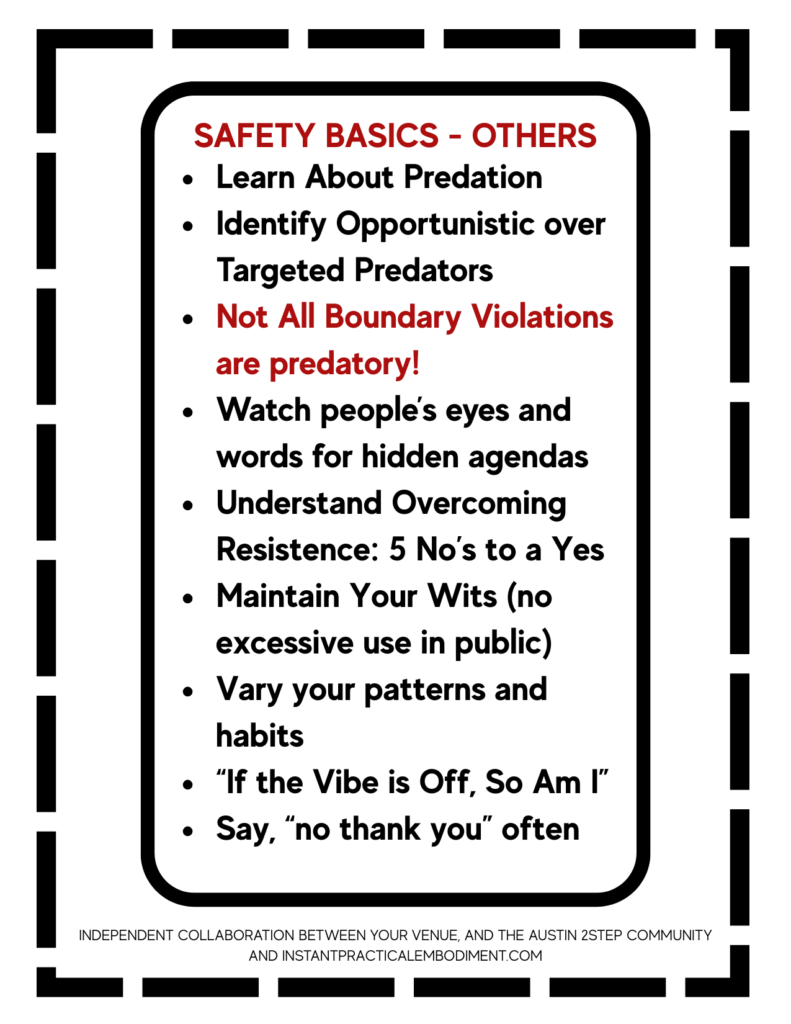
- Learn About Predation
- Identify Opportunistic over Targeted Predators
- Not All Boundary Violations are predatory!
- Watch people’s eyes and words for hidden agendas
- Understand Overcoming Resistence: 5 No’s to a Yes
- Maintain Your Wits (no excessive use in public)
- Vary your patterns and habits
- “If the Vibe is Off, So Am I”
- Say, “no thank you” often
Deeper education about the philosophy of interpersonal violence, crime, and the parts that make us vulnerable to predation, or to become a predator.

POWER, CONTROL and SAFETY:
Power dynamics are an inverted form of Safety Structure. Power dynamics position a top-down approach to Public Safety. Power is predicated upon Authority. Control is the function of enforcement which lends Power its structure. Without Control, Systemic Power Dynamics cannot exist. Control tells us: Do As You’re Told, and You Will Be Under Protection aka Safe (because of me, the institution, etc.)
Let’s quickly define Safety:
Safety — The word ‘safety’ entered the English language in the 14th century.[1] It is derived from Latin salvus, meaning uninjured, in good health, safe. (from Wikipedia)
Safety as a general description means “protection from harm,” but on a personal level, the nuances of a safe experience, or a safe internal somatic experience, are as complex and individual as each one of us.
As a professional in personal protection education, I tell all my clients: Personal Safety is the Work of a Lifetime. Just like being a parent, or being very successful in your career, you must Devote Time and Energy to your Personal Safety and Protection.
So How do we Define Safety Within Our Community?
Rather than attempt to unpack and parse the nuances of personal safety (which I offer as a 1-1 coaching service), let’s instead focus on the inherent RISKS that cause threats to that Safety: Other People.
Predator Versus Prey
There are two predominant kinds of predatory behavior: Opportunistic and Targeted.
Opportunists are easily deterred. Light to Firm resistance tactics will be too energetically expensive for these types. Simple practices like walking with a buddy or a group, carrying pepper spray visibility, looking confident and walking fast, not maintaining eye contact, etc., will deter these predators.
A Targeted or Hunter type will NOT be deterred by resistance, may enjoy the game of overcoming your resistance, and may have sophisticated strategies for navigating and overcoming based on your type. Targeted predators HAVE A TYPE and KNOW HOW TO NAVIGATE IT. You’re at an automatic disadvantage once one identifies and targets you.
These are seasoned abusers who may or may not have lucidity about the harm they cause. They can easily believe themselves innocent or victim (in the case of narcissistic abuse patterns). If a scheme goes awry, you may find yourself ostracized from mutual social circles, or targeted negatively by this individual, once they realize the original game isn’t going their way. They will likely be retributive, and feel possessory about you, the venue, the community, etc.
In Our Community: The most common strategy is to position as a leader, teacher, or escort into “the world of Austin 2-Step.”
MOST of the people in our community are well-meaning and watching out for one another, however, that same behavior can quickly turn to predation.
What to watch out for:
- Positioning of Expertise
- Negging: pointing out your inexperience, or calling out your anxious or nervous energy
- May introduce you around, to exhibit both status and social power
- Teaches you and takes you out, but controls the setting, doesn’t take feedback or your preferences and concerns in mind
- Becomes jealous if you seek other venues, other friends, or other classes/teachers
- Back-end negotiations and transactionality: “I took you here, I taught you this, you now owe me _______,” often its an ask that is meant to test your boundaries, and can include money, sex or access to other friends, etc. It isn’t about what they ask for, its about whether you AGREE.
A person who respects you will respect your boundaries, and will not push past resistance. In our community, we foster communication and safety.
5 No’s to a Yes
One of the most common techniques to overcome a person’s resistance is to continue to test their boundaries in various ways until they “cave,” or a successful Angle is discovered by process of elimination. This is a common modern dating tactic, but it is also a tool of sales people, and hunter-predators. Opportunistic predators likely won’t have the energy, patience or focus. Saying “NO,” is a great way to clear out opportunistic predators, and gain insight when a person might be a targeted or hunter predator.
What 5 No’s shows us is the malleability of Consent. We WANT to agree with our peers, to connect with new people, and to be valued by others in our community. Human beings are Social Mammals: social approval is DEEPLY tied to our survival instinct. High levels of pressure will chip away at our will and autonomy and we will begin to want to say yes.
What the 5 No’s sounds like:
“Can I buy you a drink?” you decline. The next pass, they ask for a dance and you decline. They may observe your behaviors, your friends, your drink and dance preferences, and begin to build connections around you. They may ask questions about people around you, a way of circumnavigating and being less direct, also known as Angling. If they can ingratiate themselves into your friend group, then the next time they ask or offer, you will feel more pressure to say yes. Your friends and peers might even get recruited to help. Anyone pushing past your no or your nonverbal boundary for any reason is a call to Pay Closer Attention and Gather Your Wits Around You.
The hunter-predator will also ingratiate themselves in other ways. Modernly we call this “love bombing”:
Buying drinks, being doting and sweet, demonstrating focus and attention, they may offer or take you on fancy dates. The goal of all of which is to structurally isolate you and make you vulnerable to advances and leverage.
When a Predator Isn’t Romantic:
Predation takes many forms, and comes up in ALL our interpersonal relationships because it is a function of the HUMAN BRAIN, not a choice solely made by toxic and abusive individuals. We ALL have this Predator inside of us. Every time we judge or put someone down, we’re engaging in hierarchy, external valuation, which is the doorway to predation. If I can mentally devalue someone, I can justify taking advantage of them. NO amount of self-work that I’ve ever come across can fully eliminate the Predatory function from the human brain. This means that only our Conscious Attention and Self-Control can truly protect Others from our own baser impulses.
Predators are so because they EAT. Every person stuck in a predatory dynamic inside themselves will have a different relationship with their energy source (food). Sometimes its social validation, sometimes its money, or s*x.
The list below outlines the basic universal human needs. Any one of these, or a combination, can create Predatory behavior if a person is able to justify their need and entitlement to it over another person’s safety, autonomy or rights.
The 8 Universal Needs:
- Physical Well-being
- Safety and Stability
- Connection and Love
- Appreciation and Status
- Growth and Development
- Autonomy and Freedom of Choice
- Contribution and Meaning
- Play and Pleasure
Sources: Anthony Robbins, Maslow, Deci,Susan Fowler, Max-Neef & Rosenberg,Wilber, Steven Reis, Alderfer, Fromm.
All predators share this in common: They Have an Agenda.
If you don’t play their game their way, you will eventually meet the rage, anger, hurt and pain which underlies their desperate need to control others and their circumstances. This can be a DANGEROUS period. Its important to create and maintain allies, talk to people, and remove yourself when possible from shared spaces. Eventually, all predators will move on to their next most viable meal, which means that your discomfort in dealing with them, if you maintain your boundaries and safety, is temporary. They are looking for Victims. When you cease to be a Victim, they Lose Interest and Move On.