
Crime and Violence Safety (in ATX)
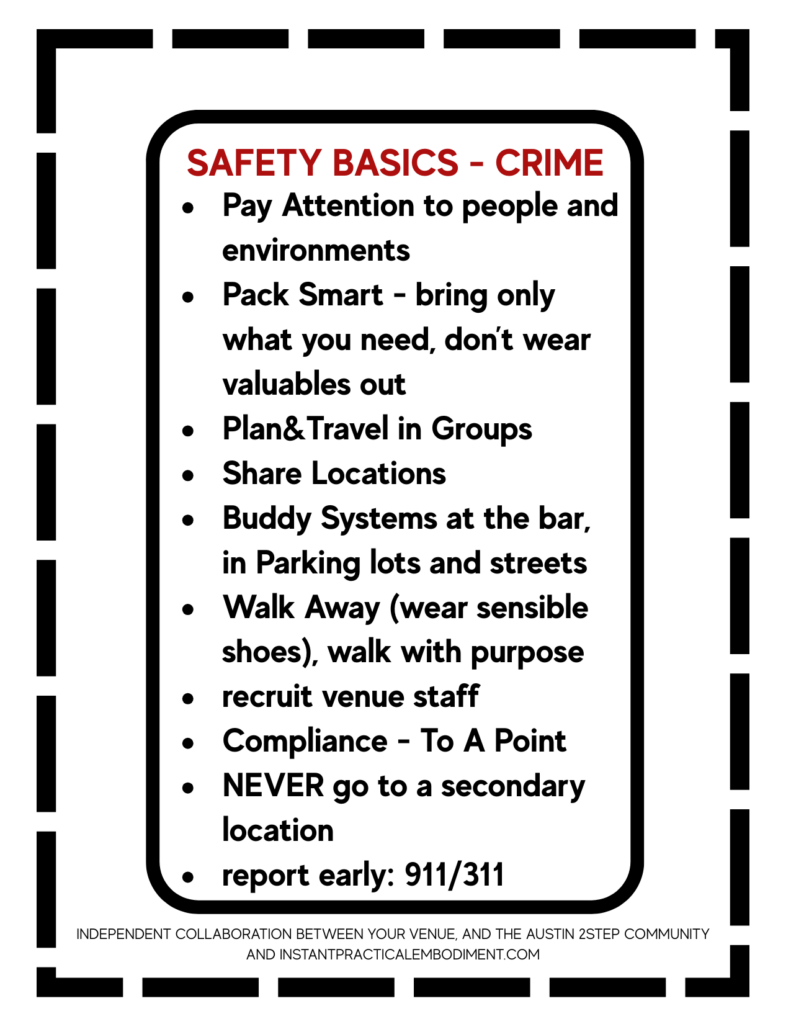
Basic info and strategies to enjoy a night out while limiting risk, regardless of the venue or event.
- Pay Attention to people and environments
- Pack Smart – bring only what you need, don’t wear valuables out
- Plan&Travel in Groups
- Share Locations
- Buddy Systems at the bar, in Parking lots and streets
- Walk Away (wear sensible shoes), walk with purpose
- recruit venue staff
- Compliance – To A Point
- NEVER go to a secondary location
- report early: 911/311
YOU are your First and Best Protection – ALWAYS!
In Austin and most metro areas in the US, Police response to URGENT, VIOLENT crimes is FIVE MINUTES. Most altercations last about TWO MINUTES. If you’re lucky, you’ll walk away with your life and unharmed, but this isn’t always the case.
The BEST Defense is ALWAYS a GOOD and PRACTICED Strategy for worst-case scenarios.
Staying Positive and believing “that wouldn’t happen to me,” is NOT a protective strategy – its an illusion that can cause you and your loved ones HARM.
In his book, The Gift of Fear, Gavin DeBecker points out the different types of intrusive engagement that can lead to boundary violation, crime, violent crime, and harm.
Predators exhibit behaviors such as looking at the object of their interest, they may exhibit aggressive or ingratiating behaviors in order to close physical or psychic distance between themselves and their Target.
Likewise, predators LOOK for certain behaviors and Tells: People who seem lost, confused, weak, innocent and compliant make great targets. People who openly display their affluence but act distracted or drunk make excellent targets. People walking alone, unaware of their surroundings, with their faces in their phones, make excellent targets.
Limiting the Risk of crime is as much about education of Others and Predatory behaviors, as it is a physical and psychic Empowerment activity. Learning and Practicing, you begin to project strength, confidence and a certain amount of Risk to anyone who would try to take advantage of you. This will shift the Power dynamics that predation relies upon.
A Few Case Studies
Behaviors that seem social and innocuous in most situations become a Warning of Risk when we consider context. For example: a young woman walking alone to her car is approached by a man asking directions. If it’s a summer day with a lot of people around, the man stays more than arm’s reach away, etc., we may assess: zero or low threat. If the context is a dark and abandoned street after 12am, and the man continues to walk towards the woman despite her eagerness to move away, suddenly the context informs us: Heightened Risk.
Personal Anecdote: As a mom and a self-defense instructor, the people I watch most closely are: men who are fully comfortable approaching children. On the playground, occasionally an older man will bring a small (cute) dog around the playscapes. This is a potential predator. Someone who has zero business near a children’s play area, with the bait of a cute and small dog (young kids are often afraid of large dogs). As a parent of small children, it is 100% within your scope to ask any individual adult standing alone what business they have at a playground. Speak loudly to them from a safe distance (more than 6 feet). ASK them which one is their kid. People who don’t have kids or family hanging around at a playground are a RISK to your children’s safety. 9/10 they will move off. Take note of their appearance, the dog, or try to get their names, if you can do it safely.
Be prepared to call 911/311 at all times when it comes to the safety of children, yours or anyone’s.
AWARENESS is your number one tool and includes proper, ongoing Education about violent crime and predation, Observation of individual behavior, environments and social dynamics, and worst-case scenario strategies that adapt to your lifestyle and circumstances.
PRESENCE is your next best asset. Your demeanor, your confidence and the resources visibly available to you can all be deterrents to victimization.
Personal Anecdote: I recently lived in an area that was a bit dicey. There was a lot of transient activity, petty crime and drug use. Assessing the environment early on, I developed a strategy: for the first 10 days after I moved in, I openly carried my firearm. I walked the area often, taking different routes and paths back home. Only one time did I ever feel grateful my weapon was ON MY PERSON, and that individual was disturbed and confrontational, but not a predator. I spoke to him loudly and firmly from 10 feet away. I took out my phone and started calling 911 when he argued with me about why he was hanging around. I SAID LOUDLY: I am calling the cops right now, you need to LEAVE. I had my other hand on my gun, prepared to draw. He moved off and I reported the incident to our private security and asked them to come check the property. The rest of the time that I lived there, the initial visual deterrent, and making myself KNOWN as a serious person in the area, kept potential assailants away.
UNPREDICABLE BEHAVIOR: Criminals aren’t typically born into criminal instinct, they are created by circumstance. The Desperation of Survival, coupled with the ongoing stress to the nervous system, creates an extremely unpredictable person. Add mental illness into the mix, and you have a person who may be desperate, lost, angry and chaotic, but STILL NOT A PREDATOR. For your own safety, you must respond to every incident from the perspective of worst-case-scenario, because you CANNOT predict what someone will do. This is why self-defense instruction and advice can feel vague. No one ever knows how they will respond until the situation in happening. No one ever knows the outcome until an altercation has ended, and likewise the trauma and aftereffects are highly individual. Some people suffer PTSD for the rest of their lives after a mugging or other potentially violent incident.
THE BEST STRATEGY IS ALWAYS A PREVENTATIVE STRATEGY.
For an in-depth dive: check out this article:
How to Survive A Mugging, stillnessinthestorm.com
NO AMOUNT OF PLANNING OR STRATEGY CAN GUARANTEE YOUR SAFETY, HOWEVER: NO PLAN is to rely on LUCK at best and the mercy of your assailant at worst.
A healthy relationship with your Instinctual Fear and Trusting Your Gut Responses is CRUCAL to your safety and longevity. This means: if you feel “weird vibes” or unsettled for ANY reason: TRUST. YOUR. GUT.
COMPLIANCE — To a point.
Most petty crime is driven by poverty and imbalanced social power dynamics. MOST crime is 1) Opportunistic and 2) Nonviolent. HOWEVER: You can NEVER fully know the intentions of another person. In a violent crime scenario, every choice you make becomes potentially Life or Death. Time will slow down, and your Nervous System conditioning will take over. This means your system will fall into: Fight, Flight, Freeze or Fawn.
Assailants RELY on collapsed nervous system responses (helplessness) and compliance.
When a Weapon is Involved — You are set at a Power Imbalance the moment a weapon is suggested (indicated in a pocket but not displayed openly), or presented openly. The majority of these tactics are meant to FORCE COMPLIANCE, not to COMMIT VIOLENCE. This is an important an essential distinction, observation of which can meant the difference of Life and Death.
When someone draws a knife, gun, etc., in an attempt to rob you: COMPLY TO THE POINT THEY DEMAND AND NO FURTHER. Give them all the money, jewelry, etc., you have. Remember: You don’t know what they REALLY WANT YET. Until they walk away, you’re in danger.
IF YOU COMPLY BUT THEY PRESS YOU FURTHER: This becomes a serious safety concern.
What to Watch For: Demands to go to ANY secondary location. Demands for more beyond the initial ask: such as: where is your car? Where is your ATM? Take me to your ATM, questions about people in your life, etc.
From this point you DO NOT KNOW where the line is, so you need that information via your Resistance.
NEVER get into a vehicle with an assailant. Get loud, try to run, try to fight. Draw attention. Once you enter a vehicle with a weapon drawn on you, you have surrendered all autonomy to what has become your captor/abductor.
These are difficult realities that most average people do not want to face and will likely NEVER face, however, these statistics (from Neighborhood Scout) demonstrate that you DO have a 1/214 chance of experiencing some form of violent crime living in Austin:
Violent Crime Rates
The following table summarizes the violent crime rates in Austin:
| Crime Type | Rate per 1,000 Residents | Chance of Becoming a Victim |
|---|---|---|
| Murder | 0.07 | 1 in 14,286 |
| Rape | 0.68 | 1 in 1,471 |
| Robbery | 0.86 | 1 in 1,163 |
| Aggravated Assault | 3.07 | 1 in 326 |
Comparison with National Averages
- Austin’s violent crime rate is among the highest in the nation when compared to communities of all sizes.
- The chance of becoming a victim of a violent crime in Austin is approximately 1 in 214.
Most people avoid educating themselves out of Fear, Avoidance and Denial, but that does NOT eliminate RISK. They BEST way to reduce Risk is 1) Education 2) Training 3) Having a Worst-Case Scenario Plan
I train people in this work. To work with me directly, check out my shop for rates.
For More Reading: Check Out the Article on Power & Control: The Roots of Predation